











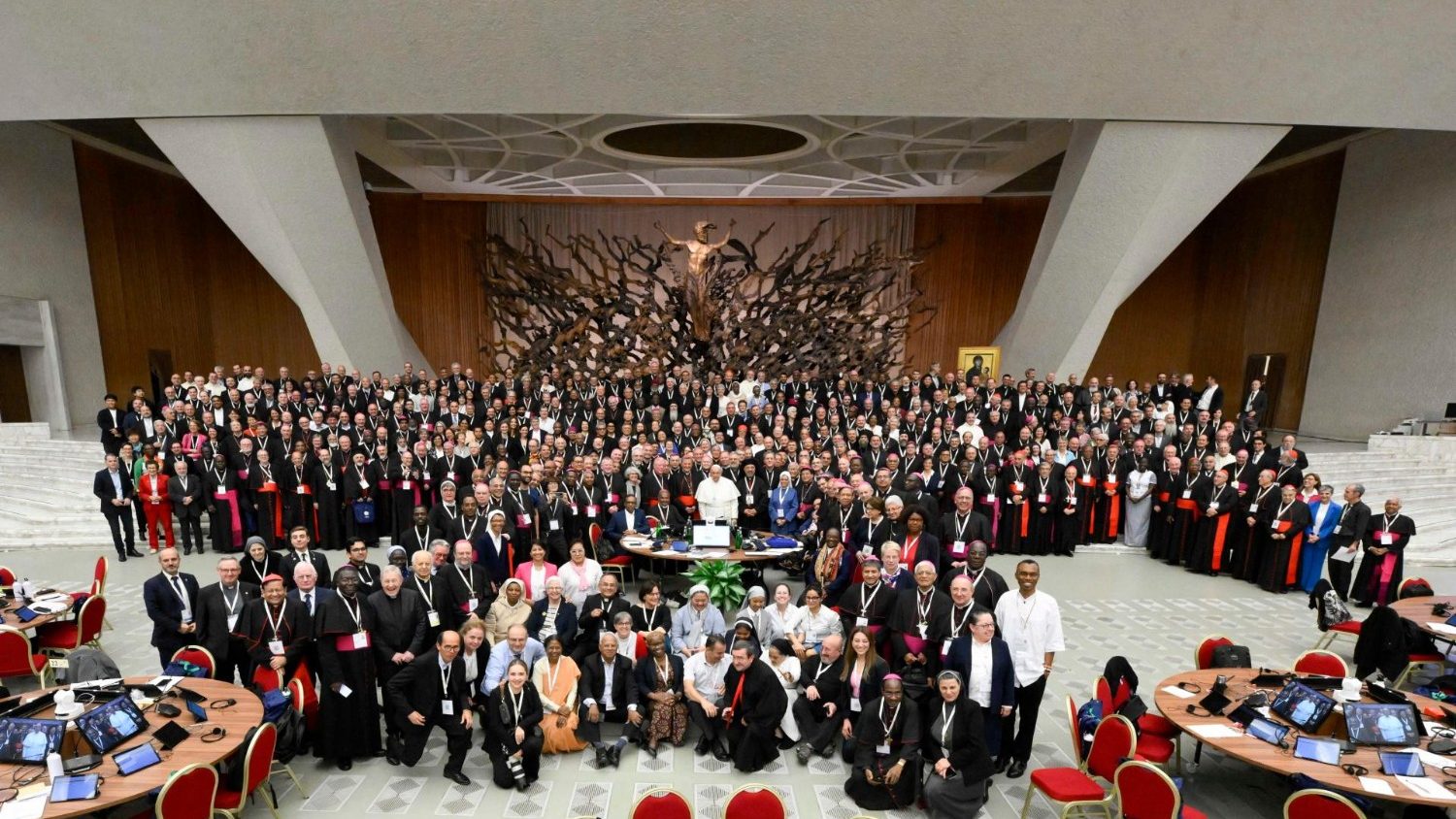
The Final Document of the second session of the Sixteenth Ordinary General Assembly of the Synod recounts and relaunches an experience of Church as communion, participation, and mission, with a concrete proposal of a new vision that overturns established practices.
By Giampaolo Mattei
VATICAN CITY — The Final Document, adopted today after each of its 155 paragraphs were approved, has been published, and will not become the basis of an Exhortation by the Pope, who has decided that it should be released immediately in order to inspire the life of the Church.
“The synodal process does not conclude with the end of the current Assembly of the Synod of Bishops, but it also includes the implementation phase” (9), involving all in the “daily journey with a synodal methodology of consultation and discernment, identifying concrete ways and formation pathways to bring about a tangible synodal conversion in the various ecclesial contexts” (9).
In particular, the Document challenges Bishops on their commitment to transparency and accountability, while noting, with Cardinal Victor Fernandez, the Prefect of the Dicastery for the Doctrine of the Faith, that work continues to provide women greater roles and greater power within the Church.
Two key words that emerge from the text – permeated by the perspective and proposal of conversion – are “relationships”, a way of being Church; and “bonds”, marked by the “exchange of gifts” between the Churches lived dynamically and, therefore, converting processes. It is precisely the local Churches that are at the centre in the missionary horizon, which is the foundation of the experience of plurality of synodality, with all the structures at the service of mission, with the laity increasingly fulfilling their role as subjects, or protagonists, of the process.
In this perspective, the Final Document emphasizes the concrete reality of being rooted in a “place”. Notably, the Synod Fathers and Mothers propose that the Dicasteries of the Holy See initiate substantive consultations “before publishing important normative documents” (135).
The structure of the Final Document
The Final Document comprises five parts, rooted in the Gospel accounts of the Resurrected Jesus appearing to the Apostles.
The first identifies “The Heart of Synodality”. The second part, “On the Boat, Together”, is dedicated “to the conversion of the relationships that build the Christian community and shape the mission in the intertwining of vocations, charisms and ministries”; while the third, “Cast the Net”, “identifies three practices that are intimately connected: ecclesial discernment, decision-making processes, and a culture of transparency, accountability and evaluation”.
The fourth part, “An Abundant Catch”, “outlines how it is possible to cultivate in new forms the exchange of gifts and the intertwining of the bonds that unite us in the Church, at a time when the experience of being rooted in a place is changing profoundly”; with the fifth, “So I Send You”, “allows us to look at the first step to be taken: caring for the formation of all, of the People of God, all synodal missionaries”.
The Wounds of the Risen One continue to bleed…
The introduction of the Document (1-12) immediately clarifies the essence of the Synod as “a renewed experience of the disciples’ encounter with the Risen One in the Upper Room on Easter evening”. “Contemplating the Risen One”, the Document continues, “we have seen the mark of His Wounds (…) that continue to bleed in the bodies of many brothers and sisters, including through our own faults. Looking upon the Lord does not distance us from the tragedies of history. Instead, it opens our eyes to the suffering of those around us and penetrates us: the faces of war-stricken terrorised children, weeping mothers, the shattered dreams of so many young people, refugees who face terrible journeys, the victims of climate change and social injustice” (2).
The Synod, recalling the many ongoing wars, joins Pope Francis in “his repeated appeals for peace, condemning the logic of violence, hatred, and revenge” (2).
Further, the synodal way is markedly ecumenical, oriented towards “a full and visible unity of Christians” (4) – and “constitutes an authentic further act of reception of the [Second Vatican] Council, thus deepening its inspiration and reinvigorating its prophetic force for today’s world” (5).
It was not easy, the Document recognizes: “We cannot deny that we have faced fatigue, resistance to change, and the temptation to let our own ideas prevail over listening to the Gospel and the practice of discernment” (6)
The heart of synodality
The first part of the document (13-48) begins with the shared reflections on “the Church as the People of God, Sacrament of Unity” (15-20) and on “The Sacramental Roots of the People of God” (21-27).
It is through the “experience of recent years” that the meaning of the terms “synodality” and “synodal” have come “to be better understood, and what they represent more vibrantly lived. They have become ever more deeply associated with the desire for a Church that is closer to people and more relational – a Church that is God’s home and family.
…
“In simple and concise terms, synodality is a path of spiritual renewal and structural reform that enables the Church to be more participatory and missionary, so that it can walk with every man and woman, radiating the light of Christ” (28).
Recognizing that the unity of the Church does not mean uniformity, “the appreciation of contexts, cultures and diversities, and of the relationships between them, is key to growing as a missionary synodal Church” (40). And with the revival of relations with other religious traditions, the Church strives “together with them to build a better world” (41).
The conversion of relationships
The second part of the Document (49-77) opens with the recognition of “the call for a Church with a greater capacity to nurture relationships: with the Lord, between men and women, in the family, in the local community, among social groups and religions, with the earth itself” (50).
At the same time the Synod recognizes that some “continued to experience the pain of feeling excluded or judged because of their marital situation, identity, or sexuality” (ibid.).
“To be a synodal Church, we are required to open ourselves to a genuine relational conversion that redirects each person’s priorities and we must once again learn from the Gospel that attending to relationships is not merely a strategy or a tool for greater organisational effectiveness. Relationships and bonds are the means by which God the Father has revealed Himself in Jesus and the Spirit” (ibid.).
They final document goes on to acknowledge “the widely expressed pain and suffering on the part of many women from every region and continent, both lay and consecrated, during the synodal process”, which “reveal how often we fail to live up to this vision” (52).
In particular, “the call to renewed relationships in the Lord Jesus flourishes in the different contexts in which His disciples live”, joined to “the plurality of cultures”; yet “interaction by people from diverse cultural contexts can also lead to distorted relationships that are not in keeping with the Gospel” (53).
“The evils that plague our world… are rooted in these dynamics”, the Document affirms, noting that “the most radical and dramatic rejection is that of human life itself; this leads to the rejection of the unborn, as well as of the elderly” (54).
Ministries for Mission
“Charisms, Vocations, and Ministries for Mission” (57-67) lie at the heart of the document, which focuses especially on a greater participation of lay men and women. The ordained ministry is “at the service of harmony” (68); and the ministry of the bishop aims at “discerning and bringing together in unity” the gifts of the Holy Spirit (69-71).
Within the discussion of the episcopal ministry, the Document notes that “in the case of titular bishops today, the constitutive relationship between the bishop and the local Church does not appear with sufficient clarity, for example, in the case of papal representatives and those who serve in the Roman Curia” (70).
Priests and deacons serve with the bishops for a “collaboration between ordained ministers within a synodal Church” (74). So, the experience of “Synodal Spirituality” is significant, for if “spiritual depth at both personal and communitarian levels is lacking, synodality is reduced to organisational expediency” (44).
For this reason, the Document notes, “practised with humility, the synodal style enables the Church to be a prophetic voice in today’s world.”
The conversion of processes
In the third part of the Document (79-108), the Synod notes that “in prayer and dialogue, we have recognised that ecclesial discernment, the care for decision-making processes, the commitment to accountability and the evaluation of our decisions are practices through which we respond to the Word that shows us the paths of mission” (79).
In particular, it notes, “These three practices are closely intertwined. Decision-making processes need ecclesial discernment, which requires listening in a climate of trust that is supported by transparency and accountability. Trust must be mutual: decision-makers need to be able to trust and listen to the People of God. The latter, in turn, needs to be able to trust those in authority” (80).
In fact, “Ecclesial Discernment for Mission” “is not an organisational technique but rather a spiritual practice grounded in a living faith” and “is never just a setting out of one’s own personal or group point of view or a summing up of differing individual opinions” (82).
“The Structure of the Decision-making Process” (87-94), “Transparency, Accountability, and Evaluation” (95-102), and “Synodality and Participatory Bodies” (103-108) are central points of the proposals contained in the Document, arising from the experience of the Synod.
The Conversion of Bonds
The essence of the fourth part of the Final Document (109-139) is expressed in its first paragraph: “In a time when there is great change occurring in the places where the Church is rooted and on pilgrimage, we need to cultivate new forms of the exchange of gifts and the network of bonds that unite us. In this we are sustained by the ministry of the bishops in communion amongst themselves and with the Bishop of Rome” (109).
The expression “Firmly Rooted yet Pilgrims” (110-119) recalls that “The Church cannot be understood apart from its roots in a specific territory, in that space and time where a shared experience of encounter with the saving God occurs” (110).
This part of the Document also gives due consideration to the phenomena of “population mobility” (112) and “the spread of digital culture” (113).
In this perspective, “our walking together as disciples of Jesus, with our diverse charisms and ministries, while at the same time engaging in the exchange of gifts among the Churches, is an effective sign of the love and mercy of God in Christ” (120).
“The guiding principle of the relationship among churches is the perspective of communion through the sharing of gifts” (124). From this starting point, the Document elaborates “The Bonds of Unity: Episcopal Conferences and Ecclesial Assemblies” (124-129).
The synodal reflection on “The Service of the Bishop of Rome” (130-139) is particularly significant. With reference precisely to the promotion of greater collaboration and listening, the Synod exhorts Dicasteries “to initiate a consultation with Episcopal Conferences and with the corresponding structures of the Eastern Churches sui iuris” before publishing “important normative documents” (135).
Forming a People for Missionary Discipleship
“The Holy People of God require proper formation so that they can witness to the joy of the Gospel and grow in the practice of synodality: first of all, in the freedom of sons and daughters of God in following Jesus Christ, contemplated in prayer and recognised in those who are poor” (141), the Document affirms at the beginning of the fifth part (140-151).
“One of the requests that emerged most strongly and from all contexts during the synodal process is that the formation provided by the Christian community be integral and continuing” (143). In this regard, too, we see the urgent need for “an exchange of gifts between different vocations (communion), in the perspective of a service to be performed (mission) and in a style of involvement and education in differentiated co-responsibility (participation)” (147).
“Another area of great importance is the promotion in all ecclesial contexts of a culture of safeguarding, making communities ever safer places for minors and vulnerable persons” (150).
Finally, “The themes of the Church’s social doctrine, such as commitment to peace and justice, care for our common home and intercultural and interreligious dialogue, must also be more widely shared among the People of God” (151).
Entrustment to Mary
“Living through the synodal process again, we have become aware that the salvation to be received and proclaimed is inherently relational”, the Document says in its penultimate paragraph. “We live it and witness to it together. History reveals itself to us tragically marked by war, rivalry for power, and thousands of injustices and abuses. We know, however, that the Spirit has placed the desire for authentic relationships and true bonds in the heart of every human being. Creation itself speaks of unity and sharing, of diversity and of variously interconnected forms of life” (154).
The text concludes with a prayer entrusting “the results of this Synod to the Virgin Mary”. “May she… teach us to be a people of disciples and missionaries together, to be a synodal Church” (155).
The full text of the Final Document, in Italian, can be found here, along with the results of the voting on each paragraph.