



By Deborah Castellano Lubov
VATICAN CITY —“Be artisans of true peace: an unarmed and disarming peace, humble and persevering, working for harmony among peoples and for the care of the Earth.”
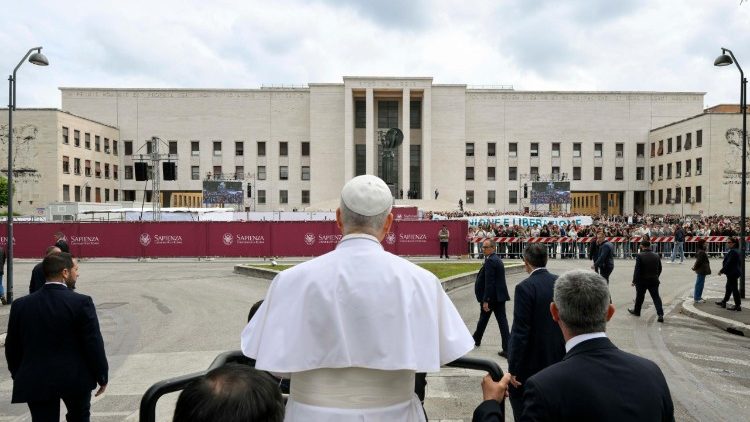
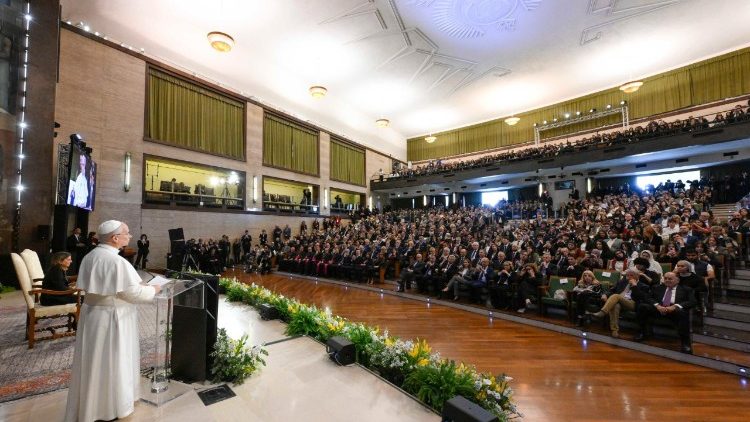
Pope Leo XIV expressed this during his address to the Sapienza University of Rome on Thursday, May 14.
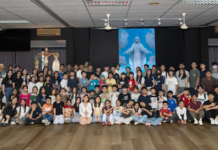
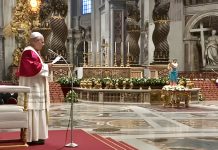
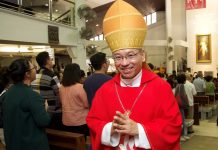
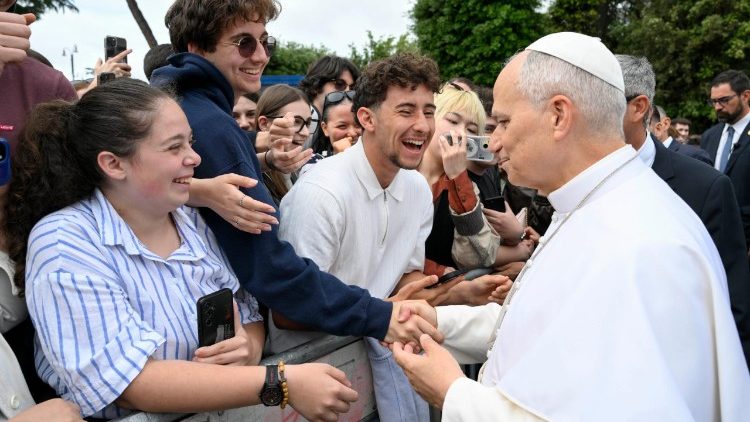
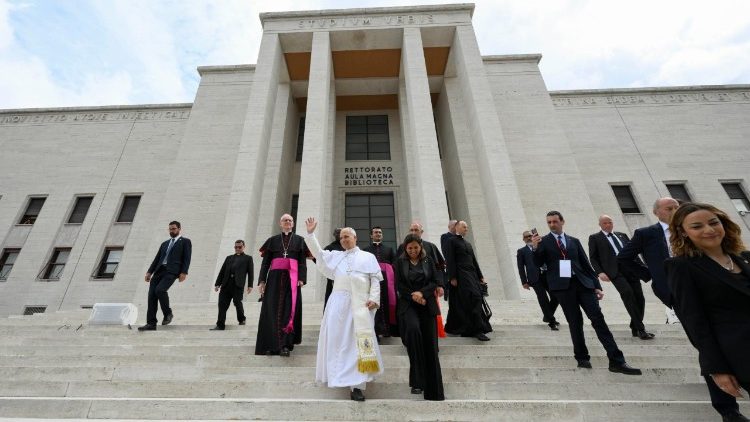
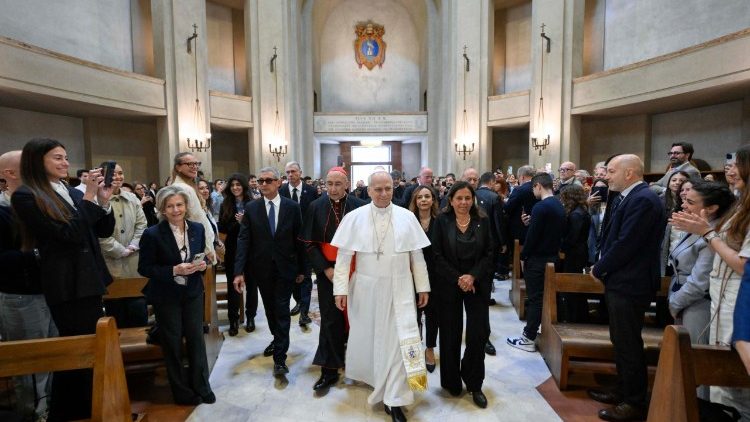
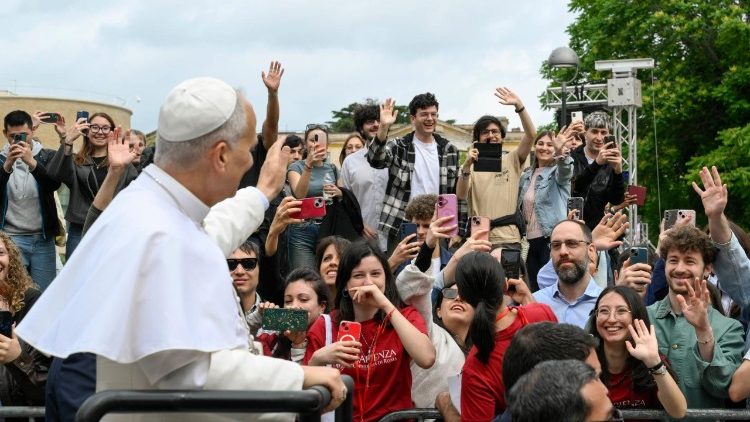
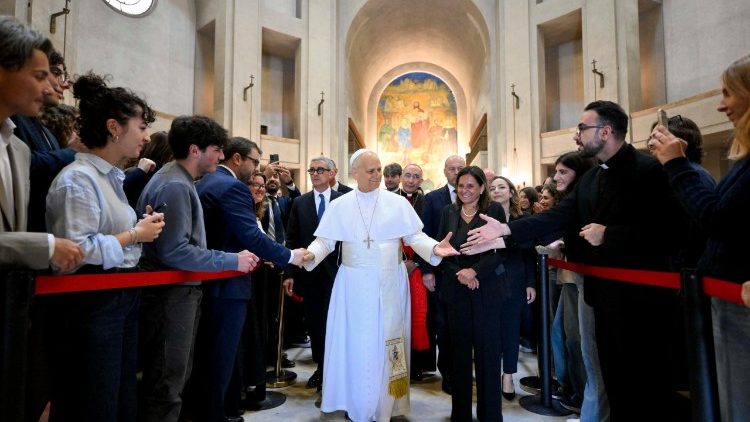
Prior to delivering his remarks, the Holy Father paused in prayer and greeted members of the university community before proceeding to the rectorate and the Aula Magna for his address.
In his speech, Pope Leo said he accepted “with great joy” the invitation to meet the university community, praising the university as a center of excellence in many disciplines, while also recognizing its commitment to ensuring access to education for those with fewer economic resources, people with disabilities, prisoners, and refugees fleeing war zones.
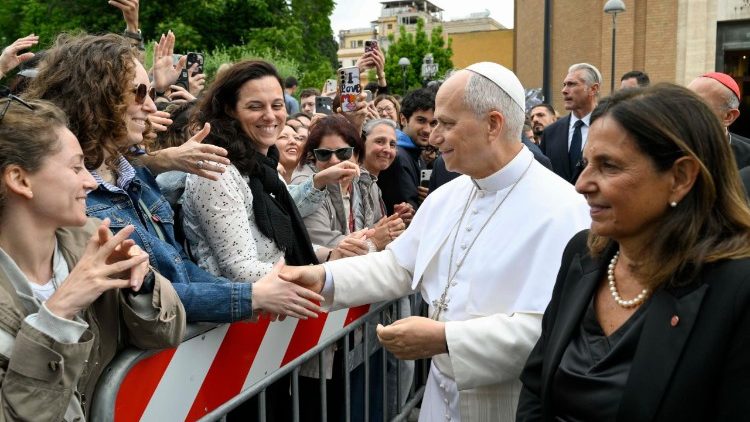
In a particular way, the Holy Father expressed appreciation for the agreement signed between the Diocese of Rome and Sapienza to open a university humanitarian corridor from the Gaza Strip.
Pope Leo noted that, having served as Bishop of Rome for just over a year, he especially desired to meet the university community and, “with a pastor’s heart,” wished to address first the students and then the professors.
Young people and the search for truth
Reflecting on his arrival at the university, the Pope said the avenues of the campus are crossed every day by many young people and marked by “contrasting emotions.”
While he acknowledged they likely have some carefree and joyful moments, he recognized that they undoubtedly are likewise troubled by the great injustices around the world.
Amid this reality, the Holy Father said studies, friendships, and encounters with “masters of thought” can transform people for the better even before changing the world around them.
“When the desire for truth becomes a search,” he continued, “our boldness in study bears witness to the hope of a new world.”
St. Augustine made serious mistakes, but never lost his passion for wisdom
Pope Leo reminded the students of his spiritual connection to Saint Augustine, his spiritual father, whom he recalled was as “a restless young man” who made serious mistakes, but never lost his passion for beauty and wisdom.
The Pope said he was pleased to receive hundreds of questions from students ahead of the encounter. Lamenting that it would be impossible for him to answer them all, he reminded the students that university chaplaincies exist for this very reason, as places “where faith encounters your questions.”
‘We are not an algorithm’
Turning to the struggles faced by many young people today, Pope Leo said “We must not hide from the fact that many young people are suffering.”
The Pope pointed to the “blackmail of expectations” and pressure to perform, calling it “the pervasive lie of a distorted system that reduces people to numbers, exacerbating competitiveness and abandoning us to spirals of anxiety.”
“This spiritual malaise,” he continued, “reminds us that we are not the sum of what we possess, nor matter randomly assembled in a mute cosmos.”
The Holy Father went on to remind the students they are not algorithms and that they possess a special dignity.
Becoming ourselves
Addressing young people directly, Pope Leo said modern malaise asks the question: “Who are you?” and said this question is one “we silently pose to God.”
“Becoming ourselves,” he observed, “is the characteristic task of every man’s and every woman’s life.”
““It is the question to which only we ourselves can respond,” he continued, “yet one that we can never answer alone,” stressing that human beings are shaped by our relationships.
‘What kind of world are we leaving behind?’
Turning to older generations, the Pope said the malaise of youth also asks: “What kind of world are we leaving behind?”
The Holy Father lamented that today’s world is “disfigured by wars and by words of war,” describing this as “a pollution of reason” that invades social relationships from the geopolitical level downward.
The Pope warned that the simplification that “constructs enemies” must be corrected, especially in universities, through “care for complexity and the wise exercise of memory.”
“In particular,” he added, “the tragedy of the twentieth century must not be forgotten.”
Warnings against military spending and rearmament
“The cry ‘never again war!’ of my predecessors,” Pope Leo said, “urges us toward a spiritual alliance with the sense of justice dwelling in the hearts of the young.”
The Holy Father noted that military spending around the world, especially in Europe, has grown enormously over the past year.
“Let us not call ‘defense’ a rearmament that increases tensions and insecurity, impoverishes investment in education and health, denies trust in diplomacy, and enriches elites that care nothing for the common good,” he warned.
Moreover, Pope Leo insisted that society must remain vigilant regarding the development and application of artificial intelligence in both military and civilian spheres.
“This is particularly important,” he said, “so that it does not strip human choices of responsibility and worsen the tragedy of conflicts.”
Warning against a ‘spiral of annihilation’
The Pope pointed specifically to Ukraine, Gaza and the Palestinian territories, Lebanon, and Iran as examples of what he called “the inhuman evolution of the relationship between war and new technologies in a spiral of annihilation.”
“Let study, research, and investment move in the opposite direction,” the Holy Father urged.
“Let them be a radical ‘yes,’” he said, “to life — yes to innocent life, yes to young life, yes to the life of peoples crying out for peace and justice.”
Safeguarding creation
A second area of common commitment, Pope Leo said, concerns ecology.
Recalling Pope Francis’ encyclical on the environment Laudato si’, the Holy Father cited the warning that “we are presently witnessing a disturbing warming of the climatic system.”
More than a decade later, Pope Leo observed, “beyond good intentions and some efforts directed toward this goal, the situation does not seem to have improved.”
In this context, the Pope encouraged young people not to surrender to resignation but instead “to transform restlessness into prophecy.”
The insight of those who believe
“Those who believe,” he continued, “know in a special way that history does not helplessly collapse into the hands of death.”
Rather, he said, history is always safeguarded by “a God who creates life from nothing, who gives without taking, who shares without consuming.”
“Today,” the Holy Father declared, “the implosion of a possessive and consumerist paradigm clears the ground for the new that is already sprouting forth: study, cultivate, safeguard justice!”
Pope Leo then invited students and professors alike to join him in pursuing peace.
“Be artisans of true peace: an unarmed and disarming peace, humble and persevering, working for harmony among peoples and for the care of the Earth,” he said.
Your intelligence and boldness is needed, the Pope said.
‘Believe in your students’
Turning specifically to professors, Pope Leo described Sapienza as “a place of study and a center of experimentation” that for centuries has formed minds in critical thought.
In this context, he reminded professors they have the responsibility and privilege of cultivating “fruitful contact with the minds and hearts of young people.”
“It is of the utmost importance to believe in your students,” the Pope stressed.
“Therefore, ask yourselves often: do I trust them?” he said.
Teaching as a form of charity
The Pope also described teaching as “a form of charity,” comparing it to “rescuing a migrant at sea, a poor person on the street, or a despairing conscience.”
Teaching, he continued, “means loving human life always and in every circumstance, esteeming its possibilities.”
Pope Leo said education should speak “to the hearts of young people” and not focus solely on intellectual knowledge.
The Pope went on to ask what would be the point of forming researchers or professionals who fail to cultivate conscience, justice, and respect for what “can neither nor should be dominated.”
A new educational alliance
“Knowledge,” he said, “serves not only to achieve professional goals, but to discern who one is.”
Through lectures, internships, interaction with the city, theses, and doctoral studies, he reminded that students can continually discover new motivations and learn to bring order “between study and life, between means and ends.”
Finally, Pope Leo XIV reminded that his visit was intended to serve as “a sign of a new educational alliance” between the Church in Rome and the university community, before assuring those present of his prayers and imparting his Apostolic Blessing.