

By Joseph Tek Choon Yee
I have often written about priests who have served for decades. Their jubilees are measured not only in silver or gold, but in baptisms, weddings, funerals, confessions, hospital visits, tired committees and the occasional expectation that the priest is also the parish multitasker.
These priests are the old rain trees of the Church, broad in shade, weathered by storms, yet still standing. They have buried our grandparents, married our parents, baptised our children, and prayed for us when words failed.
But if we only write about old rain trees, we may forget the young saplings. The Church needs saplings too.
That is why the story of Fr Terans Thadeus John Dunggi, and of other younger priests, matters. Their chalices are still young. Their sermons are still being shaped by experience. Their priestly feet are still learning the uneven roads of ministry.
This reflection focuses on Fr Terans, but also on the wider call to vocation. God still calls young men – through clear roads, detours, family duties, sacrifice and quiet perseverance. Priesthood is not only to be honoured after decades of service. It must also be encouraged, accompanied and prayed for while still young, still growing and still saying yes.
A Vocation from Sabah Soil
Fr Terans is a son of Sabah, of Kampung Kabang, Papar, born on 10 January 1988. He comes from ordinary roots, family soil and village memory. Perhaps many vocations begin there – not only in clouds of incense, but in homes where rice must be cooked, siblings cared for, parents honoured, school fees paid and faith lived through quiet endurance.
In his own testimony, one conviction returns like a refrain: God is love. His vocation did not begin with thunder from heaven. It began through the quiet witness of family faith.
One early inspiration was his grandfather, John Dunggi, whom he called Baki in Dusun. Baki was among the earliest catechists in Tambunan. As a child, Fr Terans once followed him on foot from Kampung Libang to the chapel in Kampung Garas, where Baki led the Sunday Service of the Word. He also prayed the rosary faithfully every morning. That memory of walking, praying and serving planted something deep in the young boy’s heart.
His mother’s extended family also shaped him. They were active in church ministry and, in his playful words, often “bullied” him into leading grace before meals when he was still small. Whenever the family returned to Kampung Punson, there would be family rosary prayers. Through these simple practices, he learned that faith is not only taught in church. It is lived at home, around meals, in family memory and togetherness.
Another seed was planted when his aunt and cousin, Sr Mary Ann and Sr Augustine Mary, became Putri Karmel sisters. Their example opened his mind to the possibility of giving one’s whole life to God. Something stirred within him: “Am I also called like that?” The answer was not yet clear, but the question had entered his heart.
His journey to priesthood did not move in a straight line. We like neat stories: a young man hears God’s call, enters the seminary, studies faithfully, gets ordained, and everyone claps. That is the brochure version. Life, however, rarely reads brochures.
Fr Terans had his own youthful ambitions. He once thought of becoming a teacher, then a doctor. After SPM, he entered Form Six but did not complete it, as the science stream was difficult for him then. He later continued at UiTM and took a Diploma in Science.
At 19, while at UiTM, he suffered from ruptured appendicitis and was hospitalised for a month. It was painful and humbling. Yet through that experience, he felt God’s love personally. Life became precious because it had almost been lost. From that moment, the desire to do something meaningful with his life grew stronger.
He could not yet see the full pattern. Looking back, he believes God was already working through His own mystery.
The Seminary of Family Duty
Fr Terans entered formation with the first small “yes” every vocation requires. At first, his father was unhappy with his decision, while his mother gave full support. But God works quietly. In time, his father became his strongest supporter, often asking during semester breaks when he would return to the seminary and how many more years remained.
Then life changed. In 2016, after six years in formation and during his second year of theology, his father suffered a debilitating stroke and became paralysed. As the eldest child, with younger siblings still in school, Fr Terans had to pause his dream to support the family that had given him life.
So he put his seminary studies on hold. He worked with Gammerlite Sdn Bhd, a road construction company, in quality, environment, safety and occupational health. QESH may not sound romantic. There are no stained-glass windows in workplace safety and no incense rising from occupational risk assessments. Yet God was there too.
Perhaps the Lord was forming him in another kind of seminary, the seminary of responsibility, work discipline, family sacrifice, fatigue and bills. During those years, he helped his family move into a new home, remained active in church ministry, and experienced ordinary life more fully, including the tenderness of falling in love.
Outwardly, life seemed smooth. Inwardly, there was an emptiness he could not explain. The more he moved away from the call, the more he felt it through God’s love. What looked like a three-year interruption became, in his own words, one of the best journeys in strengthening his vocation.
A delayed vocation is not necessarily weakened. Sometimes it is deepened.
When Fr Terans returned to formation, his “yes” had been tested by family anxiety, work, responsibility, love, sacrifice and discernment. It had learned that priesthood is not an escape from the world, but a deeper entry into the wounded, beautiful and demanding world God loves.
His father, once hesitant about his decision, became one of the deepest instruments of grace in his vocation. After falling ill, he once told Fr Terans, “If not because of me, you might have become a priest long ago.”
Those words touched him deeply. Instead of bitterness, he saw God’s hand at work, the intervention of His love. God is love.
A Historic Ordination
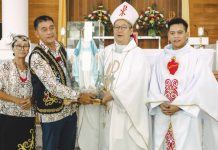
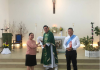
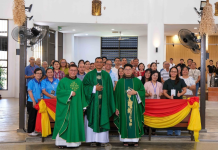
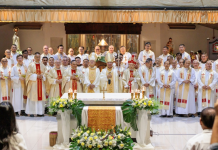
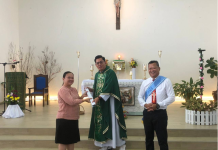
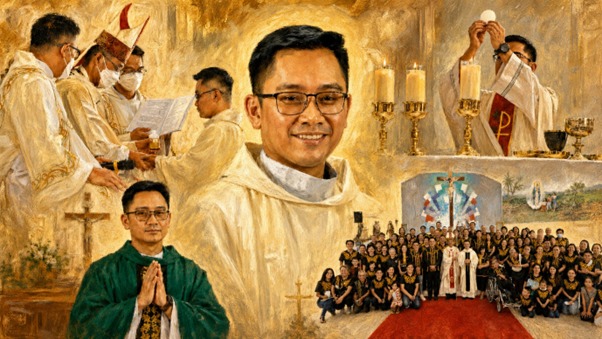
In 2022, that tested journey reached a grace-filled milestone. On 16 July, at the Church of the Holy Rosary in Limbahau, Papar, Terans Thadeus John Dunggi was ordained a priest for the Archdiocese of Kota Kinabalu by Archbishop Datuk John Wong.
It was historic. Limbahau had waited 33 years for a priestly ordination. In a world addicted to instant updates, that is a long wait. Even a government department may feel shy about such a delay. But the Church measures time differently.
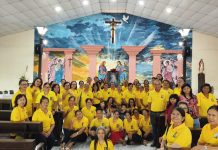
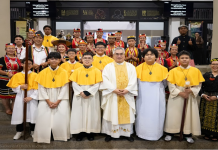
For the parish, the ordination was communal grace. A son had come forth from among them. A vocation had risen from their own soil. He was theirs – formed by family, parish, village, struggle and prayer. That is why local vocations matter.
A local priest carries not only theology, but memory. He understands the land, the humour of the kampung, and the quiet burdens of families. After Mass, people may want theology, but also a handshake, a blessing, a photo and perhaps a joke.
Archbishop John Wong’s blessing of Fr Terans confirmed the hope that Sabah can continue to raise its own shepherds. It also reminds young people that God does not discard a vocation simply because life becomes complicated.
A vocation may begin as a whisper before it becomes a vow. Fr Terans has described his journey as a small “yes” that matured into a firm “YES.” God asks for the first yes, then another, then another. Eventually, by grace, it becomes a life.
Altar, Algorithm and Rome
Since ordination, Fr Terans has served in the Archdiocese of Kota Kinabalu, including at Sacred Heart Cathedral. A young priest there must learn quickly. He must celebrate Mass, preach, listen, bless families, visit the sick, support youth, answer messages, attend meetings and appear cheerful even when tired.
He must be close without being consumed by noise, prayerful without becoming distant, and modern enough to communicate without becoming a spiritual influencer without a soul.
In my conversations with friends, one reflection stood out. A friend shared that his father, soon to turn 95, has been deeply touched by Fr Terans’ homilies. At that age, one has heard many sermons and many voices from the pulpit. Yet Fr Terans’ words still found their way to an old heart. They resonated because they were shared not merely from notes, but from the heart.
Perhaps that is one quiet mark of priestly vocation, when the Word preached does not remain above the heads of the people, but reaches their lives, memories, wounds and hopes.
Fr Terans’ public digital presence carries a simple scriptural message: God is love. That may sound basic, but basics are what the modern world needs. The phone may be full; the heart can still be empty. Digital ministry cannot replace the Eucharist or confession, but it can become a doorway to those listening quietly at midnight.
The priest is not called to be trendy. Trends expire faster than parish bulletins left under car seats. But the priest must be present.
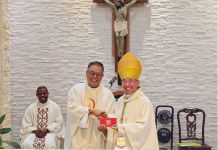
Fr Terans now begins another chapter. With a scholarship and the blessing of Archbishop John Wong, he will pursue the Licentiate in Sacred Liturgy at the Pontifical Institute of Liturgy, Sant’Anselmo, in Rome.
From Kampung Kabang to Kota Kinabalu, from Papar to Rome, that is quite a journey. This is not merely a change of geography. It is a widening of vocation.
Liturgy is the prayer of the Church. It forms God’s people, teaches reverence in a noisy world, and draws us into the mystery of the Mass. For a young priest from Sabah to study sacred liturgy in Rome is a gift not only to him, but to the local Church.
One day, God willing, he will return to help communities appreciate not only how to “do” liturgy, but how to live from it. Good liturgy forms good disciples.
Rome does not erase Sabah. Properly understood, it can root Sabah more deeply in the worship of the universal Church.
A Vocation Story for Our Time
For parents, Fr Terans’ story says a priestly vocation is not a family loss. It is a family offering.
For young people, it says God calls real people, with family struggles, work experience, doubts, duties and detours.
For parishes, it says vocations must be nurtured deliberately. Sometimes all it takes is one elder, catechist, priest, youth leader, or grandmother to ask, “Have you ever thought of becoming a priest?”
For the not-so-young priests, it says younger priests need friendship, mentoring and space to grow. Older priests carry wisdom. Younger priests carry energy. The old rain trees must shade the saplings, not block the sun. A golden jubilarian can inspire awe. A young priest can inspire possibility.
Many vocations begin with a perhaps. Perhaps God is asking. Perhaps I should listen. Perhaps the small yes is enough.
Fr Terans’ vocation story is not about glamour. Priesthood is sacrifice, obedience and service. It is carrying the joys and wounds of many people, while standing at the altar aware that one’s weakness has been drawn into Christ’s priesthood.
But it is also joy – blessing a child, hearing confession, witnessing mercy, anointing the sick, preaching hope, walking with youth, seeing a parish come alive, and knowing one’s imperfect life is being poured out for something eternal.
His journey reminds us that God still calls. The call may be quiet, delayed or interrupted. It may pass through hospital rooms, family burdens, office work, seminary corridors, parish halls or anywhere. But when it is of God, it endures.
The Church in Sabah should tell these stories, older priests whose lives have become long homilies of faithfulness, middle-aged priests quietly holding parishes together, and young priests whose vocations are still unfolding. For in every generation, the Church needs someone to say yes.
A small yes. A tested yes. A joyful yes. A priestly yes. And from that yes, God does the rest.
As Fr Terans continues his journey to Rome, we wish him every blessing. May this new chapter deepen his priesthood, strengthen his vocation, and root his mission ever more in humility, love and faithfulness.